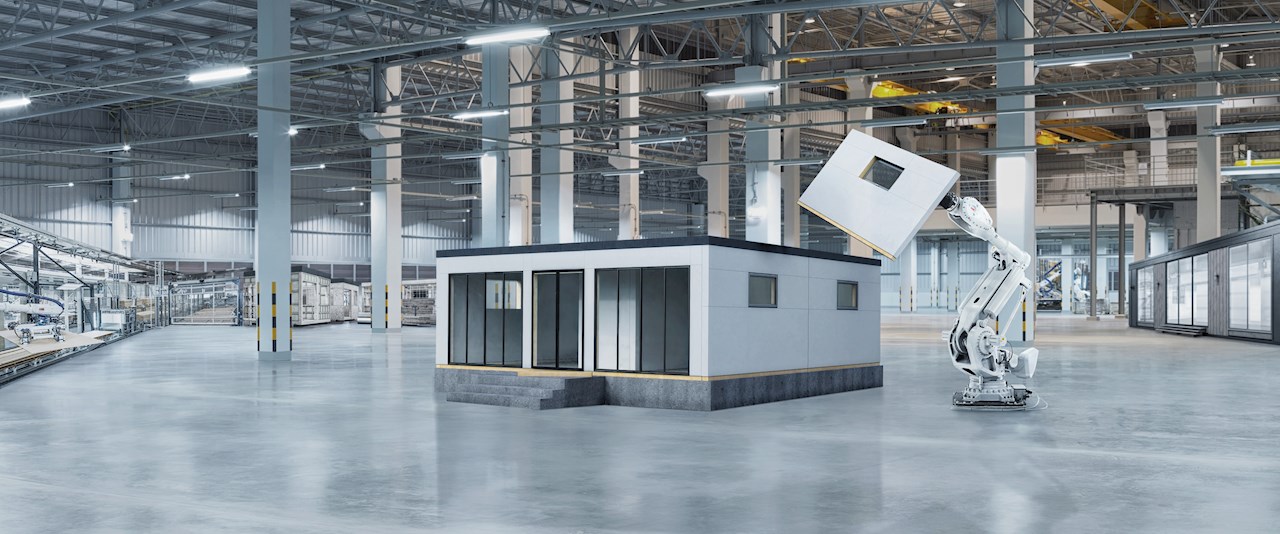
ABB Robotics and Porsche Management Consulting recently announced a pilot collaboration project aimed at developing innovative automation applications in modular housing manufacturing to drive the automation process in the construction industry. With the increasing shortage of labor in the construction industry and the growing demand for new and improved housing, it is expected that the automation level of the construction industry will increase by 85% by 2030.
Against the backdrop of a widespread shortage of labor and skilled personnel, this collaboration will help meet the market's demand for more economical and sustainable buildings, and reduce the impact of buildings on the environment. Eberhard Weiblen, Chairman of the Executive Board of Porsche Management Consulting, said, "The construction industry is facing many challenges, and highly automated construction factories will provide higher quality and more affordable housing. We hope to drive this important industry transformation by combining ABB's leading robot solutions with our expertise in modern factory planning and operation
Ma Sikang, Global President of ABB Robotics Business, added, "By automating the modular component manufacturing process, we have the opportunity to change the industry and the way houses are built. More extensive and intelligent automation can effectively solve the common labor shortage problem. This cooperation will help improve production efficiency, achieve greater customization, and promote more sustainable and efficient building manufacturing
The labor shortage problem in the construction industry has always been prominent. Taking the United States as an example, labor shortages have led to a housing shortage of nearly 4 million units, while in Germany, it is expected that by 2030, 35 cities will experience a shortage of housing supply. The traditional construction industry is striving to meet people's demand for new houses, while also seeking to improve the environmental performance and efficiency of buildings and promote more sustainable building methods. These measures include reducing the amount of raw materials transported to construction sites, as well as lowering the cost and impact of cleaning up unnecessary materials and waste.
Modular construction will further reduce material waste and decrease the number of working days lost due to adverse weather conditions, thereby improving production efficiency. In addition, factories provide a safer and more comfortable working environment. In the traditional construction industry, construction workers account for about 30% of work-related injuries, and the probability of fatal accidents is four times that of other industries.
Although the construction industry lags behind other industries in adopting automation and robotics technology, surveys show that 81% of construction companies plan to introduce or increase the use of robotics technology and automation equipment in the next decade. Eberhard Weiblen from Porsche Management Consulting emphasizes the importance of sustainable housing and believes that applying technology and expertise to the construction industry will have a positive impact.
Ma Sikang summarized, "We will turn blueprints into reality and demonstrate how robot modular buildings can support the changes needed by society. Such collaborative efforts will elevate modular buildings to a new level in terms of quality, efficiency, design, and sustainability